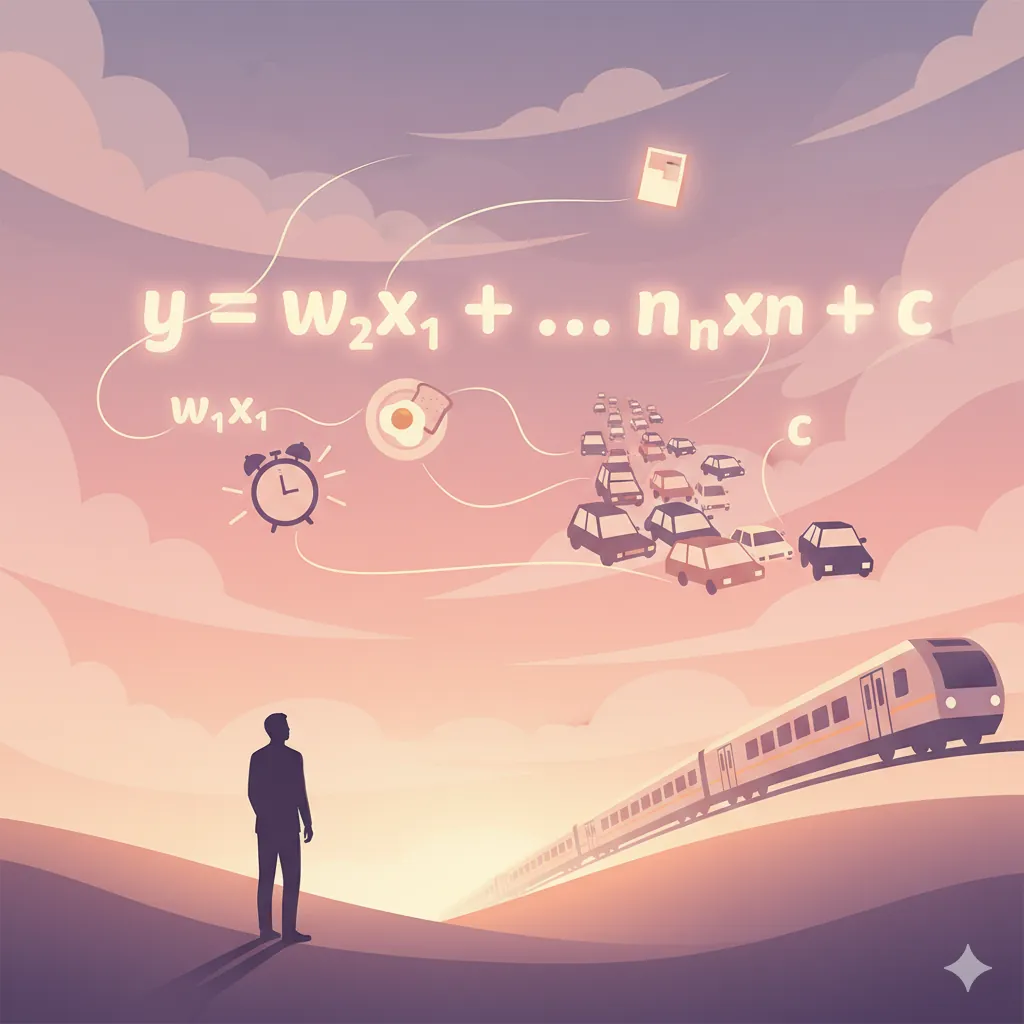
When I started learning ML, I was first introduced to Linear Regression. In short, it describes an algorithm where you can model a function using a linear expression:
y = wx + c
Largely similar to the equation of a straight line. Here, the value of y (dependent variable) changes with x (independent variable).
Now, if we extrapolate this to multiple independent variables:
y = w₁x₁ + w₂x₂ + … + wₙxₙ + c
In most use cases of linear regression, this is the case. An outcome or output is dependent on multiple factors.
Suppose you’re modeling the house price of a city using linear regression. You’ll find that historically, the price of a house depends on multiple factors - area, number of rooms, sq footage, parking (available or not), and so on. The Linear Regression algorithm tries to find those coefficients - w₁, w₂, … wₙ - and we get a model (or equation) on which, if we feed in new values of x₁…xₙ, we can “predict” or “estimate” the cost of the house in question.
Now, the idea of this blog is not to deep dive into LR. It’s because I seem to find a parallel between everything in life and this mathematical concept - not the linear part, but the combination part where everything is a combination of multiple things with different scaling factors associated with each of them.
For example:
Suppose you missed a train on a certain day. You become extremely angry and start blaming your mom for apparently “making you late” by asking you to eat breakfast before leaving. But this is black-and-white thinking - sure, it might have played a role. But there are other factors here as well to consider. Like the fact that you slept late last night despite knowing you have a train to catch the next day. Also, the traffic at that time was more than usual.
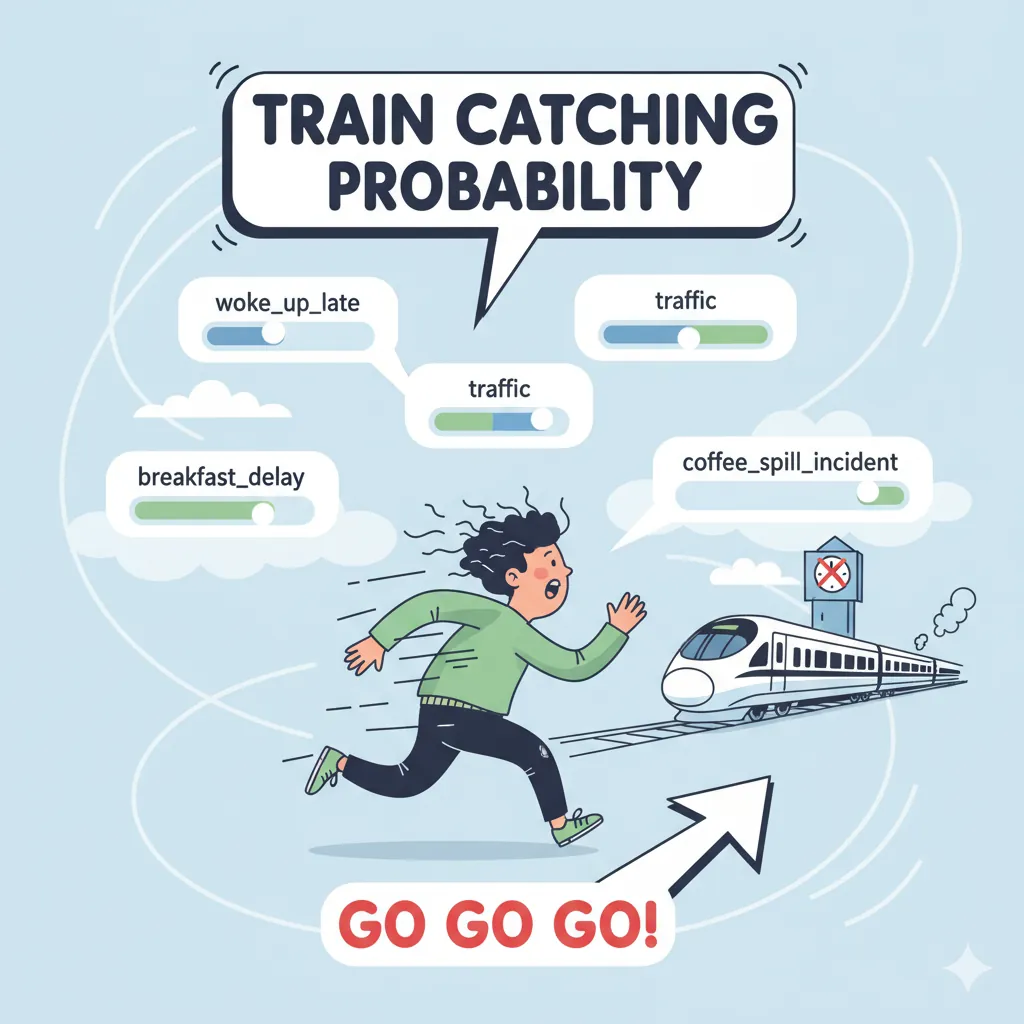
If I were to put it in the equation:
minutes_late = w₁(breakfast_delay) + w₂(woke_up_late) + w₃(traffic_level) + w₄(distance_to_station) + w₅(train_punctuality) + c
Where:
- minutes_late = how many minutes late you arrived at the station (or how close you were to missing the train)
- breakfast_delay = time spent on breakfast (in minutes)
- woke_up_late = how late you woke up compared to planned time (in minutes)
- traffic_level = traffic congestion factor (could be 1-10 scale, or actual delay in minutes)
- distance_to_station = distance you need to travel (in km)
- train_punctuality = how early/late the train typically runs (in minutes)
- c = baseline constant (accounts for other unmeasured factors)
The weights (w₁, w₂, w₃, etc.) represent how much each factor contributes to the outcome. For instance:
- Maybe w₂ is large because waking up late has a huge cascading effect
- w₁ might be small because breakfast only added 5 minutes
- w₃ could be moderate depending on how unpredictable traffic is
The more experiences I have in life, the more I resonate with this.
Now, I know real linear regression has assumptions about linearity and independence that life often violates. But as a mental model for thinking about multiple factors contributing to outcomes, it works surprisingly well.
This also helps me approach differences in opinions in a calmer and composed manner. Let’s say India wins a cricket match - some say it was because of Virat’s ton. Some say it’s because of Bumrah’s fifer. Or some say it was because of Rohit’s quickfire 25 off 10 balls.
I say it’s all of that. Just with different weights.
Another example:
Someone says, “They broke up because he was toxic.”
But reality?
relationship_strain = w₁(miscommunication) + w₂(incompatible goals) + w₃(external stress) + w₄(personality issues) + w₅(past baggage) + c
We love single-factor explanations because they’re simple. But life is multivariate, not binary.
Ever since I started viewing life through this lens - not the linear part of Linear Regression, but the weighted combination part - I’ve become less judgmental, more curious, and surprisingly more forgiving.
Because nothing “just happens.”

Outcome = Σ (all factors × their weights) + some randomness
And most of us are just bad at estimating the weights.
More from my blog
- ReelCraft: AI-Powered Article to Video Pipeline - How I built a system that transforms articles into engaging short-form videos
- Frame AI: Building an AI-Powered Photography Assistant - How I built an AI system that analyzes and enhances photos while teaching me
- Coding in the era of LLMs - My thoughts on AI-assisted coding and the importance of learning fundamentals
- Your Feelings Lie to You (Sometimes) - My exploration of how emotions and logic shape our decision-making process